


CHOOSING THE RIGHT EQUIPMENT IN CALISTHENICS
What Do You Really Need?
This article is not written to sell calisthenics equipment, but to help you understand when and why to use it.
Progress in calisthenics doesn’t always come from training more. More often, what slows progress is a set of habits that continue unnoticed. Factors that may seem minor—such as choosing the wrong program, managing intensity poorly, or rushing the process—can lead to stagnation over time. In this article, we examine the seven most common obstacles to progress and why they matter.
Equipment Isn’t Essential. Awareness Is.
Calisthenics, at its core, is a training system based on bodyweight movements. This simplicity often leads to the belief that equipment is unnecessary. From a technical standpoint, this isn’t entirely wrong. In practice, however, using the wrong equipment can become one of the key factors that slows progress.
Equipment is not used to make movements easier, but to manage load more effectively, improve movement quality, and support long-term sustainability. When used at the right time and for the right purpose, equipment helps reduce injury risk, clarifies progression, and enables more consistent development over time.
BEFORE YOU CONTINUE: BALANCE MATTERS
One of the most common mistakes in calisthenics is viewing progress solely as moving on to harder movements. In reality, progress isn’t always about difficulty, but about training with greater control and awareness.
Too much equipment distracts focus.
Avoiding equipment altogether often means overlooking the body’s limitations.
The purpose of this article is not to tell you which equipment you should own, but to help you understand what you truly need and when.
01 - PARALLETTES

Why Might It Be Necessary?
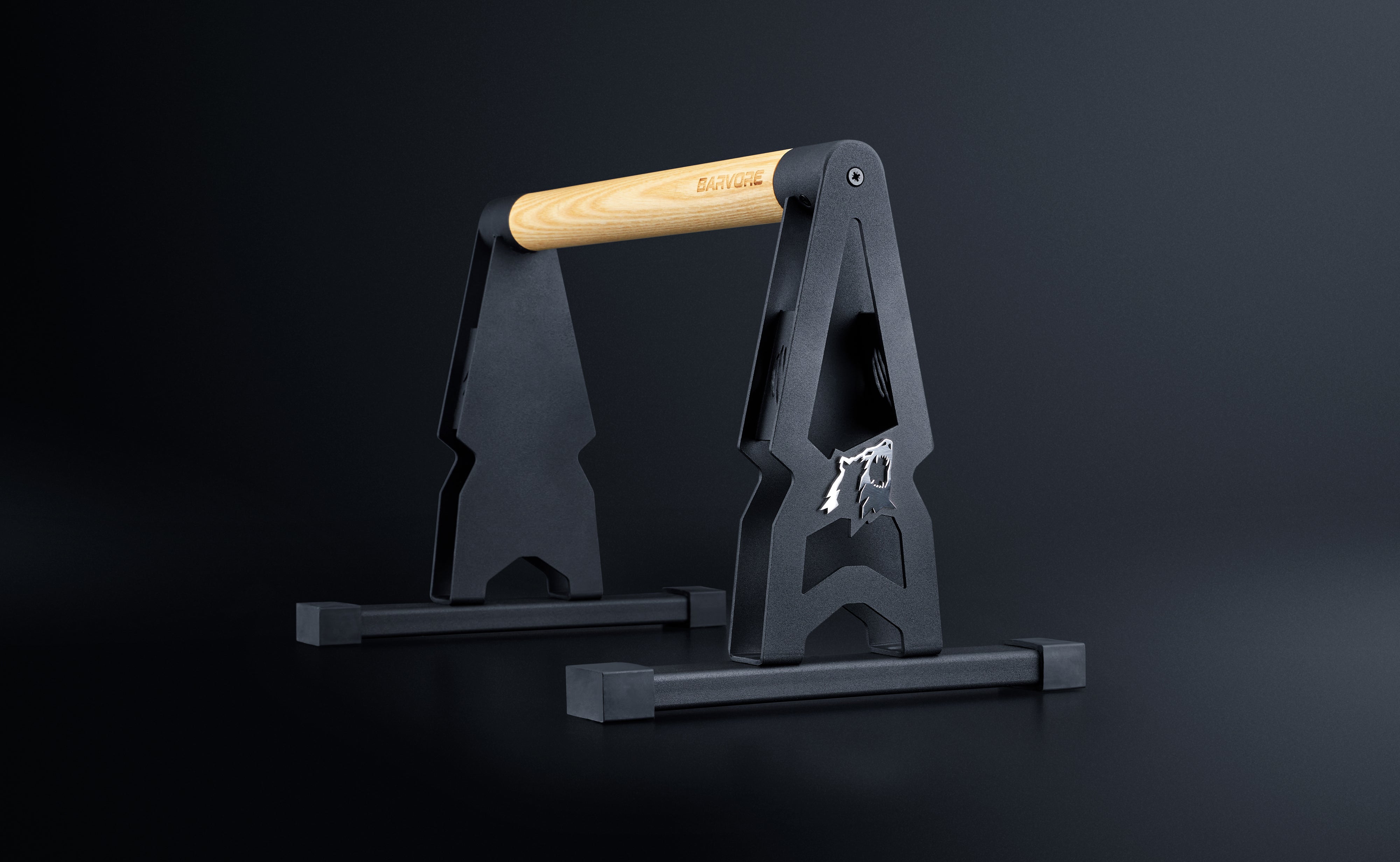
Pushing movements performed on the ground are not ideal for everyone. Especially for athletes with wrist extension sensitivity, flat surfaces can lead to discomfort and restricted movement over time. Parallettes place the wrists in a more natural position, reducing unnecessary stress on the joints.
What Does It Offer?
Using parallel bars provides a more controlled contact surface during pushing movements, increasing movement depth and consistency between repetitions. As a result, movement quality becomes more noticeable in skills such as push-up, l-sit, and planche.
Consistent contact with a stable surface allows force to be transferred to the ground more efficiently. A clearer sense of scapular positioning increases control during variation work and makes the progression process more measurable.
Additionally, parallettes provide a training environment that closely reflects the movement standards commonly seen in competition formats, supporting the adaptation process.
When Is It Unnecessary?
If basic pushing movements can be performed pain-free, with control, and through a full range of motion, parallettes are not essential. Rather than being a requirement, they should be viewed as a smart option for athletes with specific limitations.
Equipment used at this stage: Parallettes
02 - DIP BARS

Why Might It Be Necessary?
Dip bars are among the first pieces of equipment many athletes invest in when starting calisthenics. Their versatility makes them an efficient foundation for building fundamental strength and developing a wide range of movement patterns.
What Does It Offer?
Beyond foundational movements such as dips, Australian pull-up, l-sit, and leg raise, dip bars also provide a platform for developing advanced skills like the front lever and planche.
Their ability to support pushing, pulling, and core-focused training makes dip bars one of the most versatile pieces of calisthenics equipment available.
When Is It Unnecessary?
Dip bars may not be essential if your training is limited to basic bodyweight exercises such as push-up, sit-up, and squat. However, they offer considerable advantages for athletes seeking greater exercise variety and long-term progression.
Equipment used at this stage: Pro Grade Dip Bars
03 - RINGS

Why Might It Be Necessary?
Fixed bars and parallel surfaces place movement within a predefined pattern. Rings, on the other hand, constantly challenge the body to seek balance at a micro level. This creates an important stimulus, especially for athletes aiming to develop shoulder stability and core control.
What Does It Offer?
In addition to strength, rings develop coordination and neuromuscular control. Pulling and pushing movements become more “honest,” allowing asymmetries and weak links to surface more clearly. Over time, this contributes to a more balanced upper-body development.
When Is It Unnecessary?
If basic pulling and pushing capacity has not yet been developed, rings can introduce unnecessary complexity at an early stage. In this case, focusing on achieving sufficient control in fundamental movements is a more appropriate approach.
Equipment used at this stage: Performance Rings
04 - RESISTANCE BANDS

Why Might It Be Necessary?
Some movements may sit just beyond the current strength level. Resistance bands come into play at this point. The goal is not to make the movement “easier,” but to allow training at the appropriate level of difficulty without losing control.
At the same time, resistance bands can also be used to increase load in certain movements. As band tension increases during specific phases of the movement, it allows force production to be managed more deliberately.
What Does It Offer?
Resistance bands make progression more measurable. They help keep technique at the forefront during pull-up transitions, isometric holds, and the early phases of static movements.
When used as a load-increasing tool, resistance bands challenge force production in weaker phases of a movement, reinforcing control. This approach helps ensure that progress is deliberate, structured, and sustainable rather than random.
When Is It Unnecessary?
Using resistance bands continuously and with excessive assistance can mask the true demands of a movement. When band-assisted loading is increased without control, perceived difficulty may take priority over movement quality. For this reason, band use should be limited by a clear purpose and an appropriate dosage.
Equipment used at this stage: Elite Resistance Bands
05 - SUPPORT EQUIPMENT

Why Might It Be Necessary?
As training volume and intensity increase, the load placed on the joints also rises. Support equipment is used not to alter the movement itself, but to stabilize the joints. It plays a preventive role, particularly during periods of high repetition volume and intense training blocks.
What Does It Offer?
When used correctly, wrist wraps and elbow sleeves enhance training sustainability. By reducing unnecessary strain and performance drop-offs, they help athletes maintain a more consistent training process.
When Is It Unnecessary?
Support equipment should not be used to compensate for a lack of strength. In low-intensity or technique-focused training sessions, these tools may not be necessary. What ultimately matters is the level of load and the purpose of the training.
Equipment used at this stage: Wrist Wraps & Elbow Sleeves
06 - LIQUID CHALK

Why Might It Be Necessary?
Intense training sessions can lead to grip loss caused by sweating, which may negatively affect both performance and movement quality. Advanced Liquid Chalk helps provide a more controlled and consistent grip experience.
What Does It Offer?
Supports grip performance during pull-up, muscle-up, front lever, planche, and other grip-intensive movements. Especially during high-volume training sessions, it helps maintain a stable and reliable grip for longer periods.
When Is It Unnecessary?
May not be necessary when grip strength is already sufficient and hand performance is not a limiting factor. However, it can provide a significant advantage during training where grip performance plays a critical role.
Equipment used at this stage: Advanced Liquid Chalk
COMMON EQUIPMENT MISTAKES
When not used correctly, equipment slows progress rather than accelerating it.
The most common mistakes include:
Although these mistakes may create a sense of progress in the short term, they increase the risk of loss of control and injury over the long term.
EQUIPMENT APPROACH BY TRAINING ENVIRONMENT
The training environment is not the only factor that determines equipment needs, but it directly influences how equipment is used. Training at home, in the park, or in the gym changes both how equipment is applied and the purpose it serves.
In a home training environment, equipment selection is often shaped by space, ease of setup, and repeatability. When planned correctly, the same equipment can support a long-term and consistent training routine.
In park and outdoor training, portable and adaptable equipment tends to take priority. In a gym environment, however, increasing equipment variety makes load and volume management more critical. For this reason, regardless of the setting, the key is being able to identify whether the equipment being used is truly functional.
Conclusion: More Than You Need Slows Progress
In calisthenics, equipment is not the goal but a support that addresses specific needs. The right equipment is not used to make movements easier, but to make them more controlled, safer, and more consistent.
Progress is not determined by how much equipment you own, but by when and why you use it. In the long term, real progress comes not from having more, but from accurately reading your training level and using the right tool at the right time.